Monday, 23 September 2013

Portrait of an English Nobleman

Fiction ~ novella / long short story
Published 17th September 1937*
Approx. 22,000 words
(First read 23/09/2013)

This is the first in Benson's quartet of novellas published under the title Old London.  There's no connexion between the four other than the setting.
This was quite good fun.  It's set in the Georgian period ... to be precise in the very last year of that period, 1829-30.  It's the kind of romp you'd expect of Georgian gents (mistress in a pied à terre in London; frosty wife and kids at home in the country ...), and with lashings of historical detail ~ hardly profound but entertaining enough.

*These four books were only published in the United States.
[10/2014] I saw one of the originals in a secondhand bookshop in Wales the other day ~ the only one I've ever seen.  I didn't buy it because I've already got a set of the modern reprints.   At least, I assume they're modern reprints ~ if not, they're in remarkably mint condition, notwithstanding the lack of any dust-jackets.

Thursday, 19 September 2013

Juggernaut

Fiction ~ novel
Published 1911
Approx. 105,000 words
(First read 19/09/2013)

Juggernaut¹ tells the story of Margery Morrison's marriage to Arnold Leveson, of her cousin Walter's thwarted love for her, and ... well, that's about it, really.
When we first meet Margery she is sixteen-going-on-seven, bawling her eyes out over a kitten which has supposedly been drowned at the orders of her wicked aunt (Mrs Agnes Morrison, widow).  Marge is an orphan who has lived with said aunt and her cousins (Olive and Walter) for the past few years.  The latter is two years Marge's senior and Benson Type No. 1; the pair have grown up as thick as two short planks ~ oops, sorry, I mean 'as thick as thieves'.  But lo! over the course of a walk, during which it turns out the kitten hasn't been drowned after all (phew! that's a relief), Walter suddenly grows up and realizes he's in love with his couz.
Our heroine, as I've subtly hinted already, is a simple lass: to give her her due, she's the first to admit, on more than one occasion, that she's 'not very clever' ~ a bit of an understatement.  However, she makes up for her lack of brains by being sweet, flawlessly pretty, remorselessly optimistic, open-hearted, generous, pure in spirit and outlook, kind to animals, loving, virginal, saintly ... yes, she's Benson Young Female Type 1: so entirely good that you find it impossible to believe in her.  EFB does his best to convince us she's a bit of a tomboy (or maybe he uses the term 'romp'), but with little success: he's so obsessed with slathering on the 'tiny hands and feet', 'masses of silky hair', 'porcelain complexion' etc. etc. that you're left with the girliest tomboy that ever was. 
Into this cozy mix is thrown (very gently) Mr Arnold Leveson, an elderly bachelor (he's about 30 ~ joke!) and all-round dry-old-stick.  His great passion in life is writing incredibly long and tedious books about Ancient Greece ~ we're treated to a few quotes: they gave me the dry-heaves, I can tell you.  Margery raves about them and, now that Walter has been safely packed off to Germany (!), very soon ends up raving about Arnold himself.  They get married.  Marge is obviously ~ yes, obviously ~ so lacking in any kind of insight that when, on his return, Walter tells her he's over her and he's fine with her marrying Leveson, she believes him.  Walter proceeds to hang stoically around for the rest of the novel, confounded self-sacrificing idiot that he is.
Unfortunately, the marriage doesn't turn out well, to put it mildly².  It becomes clear that Arnold loves his Ancient Greek περίττωμα³ more than his wife.  Margery joins Walter in the Suffering-in-Silence corner.  The End.
No, I don't think I've forgotten anything ... other than: Margery's aunt.  Mrs Morrison is the closest Juggernaut gets to comedy: she's another of EFB's 'classic' middle-aged ~ but prematurely-agèd ~ embittered cows, a close relative of (e.g.) Mrs Hancock over at Arundel [qv].  The difference between the two is that Mrs M is actually pretty rubbish at her selfish manipulatings, constantly putting her foot in it, giving herself away, etc.  But she's nasty to everybody ~ her niece, her own kids, her neighbours, no-one escapes.  Sadly there isn't enough of her, though, to rescue Juggernaut from being a pretty tedious read: the plot is wafer-thin; Margery you just feel like punching; Walter is a moron; Arnold, though 'bad', is as dull and irritating as everyone else; only Walter's sister Olive shows occasional flashes of what might be called 'character', but she's a pretty minor character all told.   


¹ Published in the USA under the title Margery, which is far more sensible.  The UK title suggests a great deal of movement and noise: the novel has neither.
² Without giving too much away (!), I'll just tell you there's another heart-stoppingly callous Bensonian infanticide involved ...
³ The English is one syllable long and rhymes with grit.  Don't blame me if I've got this Greek word wrong: Greek isn't my thang ... obviously. 

THE CRITICS
 
"Juggernaut" in this book is performed by the man, who marries the very attractive heroine, and then allows his literary work so completely to absorb him that her married life becomes a complete failure. Even his wife's health is sacrificed by Arnold Leveson to his book; it is hard to believe that a sane human being could possibly be so absolutely egotistical. The book is written with Mr. Benson's usual powers of observation and analysis, but the nature of the theme is a constant source of irritation. It is impossible to avoid a wish that the scholarly Arnold should meet with some sudden disaster, as that would be the only possible way in which his unfortunate wife, Margery, could be restored to happiness. He declines to allow anyone to come to the house, for fear of disturbing his hours of work, and poor Margery is obliged even to drop her piano playing, in which she might have found an absorbing hobby. The minor characters are well drawn, and the portrait of Margerv's aunt, Mrs. Morrison, is so carefully studied that she is quite entitled to a place as one of the four principals of the book. But here, again, is a study of a purely self-centred egotistical person, and two characters of this sort in one book overweight it with non-conductors of sympathy.
~The Spectator, 04/11/1911
The central issue in Margery, by E. F. Benson, is whether a young woman, replete with the joy of living, can find happiness in marriage with a man who has never in his life known a passion warmer than his delight in Grecian urns and Tanagra figurines. Margery is the child of an ill-assorted marriage; and when, as a forlorn little orphan, she first comes to live with her father's relatives, her aunt Aggie takes good care not to let her forget that her mother was a mere vaudeville dancer. Margery is not malicious or vengeful, but just a sweet, wholesome, not over brilliant girl, whose innate goodness men unconsciously recognise. That was the explanation of the failure of all her Aunt Aggie's too obvious manoeuvres to keep Margery in the background, and marry off her own daughter, Olive. Almost simultaneously Margery has the task of refusing an offer from Cousin Walter, Aunt Aggie's only son, and from Arnold Leveson, whom Aunt Aggie already felt sure of as a son-in-law. Arnold Leveson had all his life been a student and a recluse. He had already written one epoch-making volume on the Alexandrine Age, and was now engaged on a companion work, the Age of Pericles. The wonder was that, in his absorption in antiquities, he ever raised his eyes high enough from books to rest them on Margery's face. But such happened to be the case, and presently they were married. And then, for a while, the experiment succeeded. But after the honeymoon and a brief season of London gaiety, Arnold felt a return of the old fever of study, the old impelling need of creative work. From that moment, Margery's loneliness began; and the rivalry was harder than that of another woman, because against a woman she could have offset her own charms, but she was powerless against ancient tomes and crumbling marble. Mr. Benson did not lack a big issue, but of his own accord he dodged it. What Margery and Arnold would in the end have made of their lives, he refused to tell us, because one fine day in Athens, antiquarian zeal led the man a step too high upon a tottering ruin, and when he and the ruin fell together, he was undermost. It is vexatious when a novelist has all the elements that go to make up a human problem of vital interest, and then deliberately shirks his task.
~Frederic Taber Cooper in The Bookman (US), 11/1911

Tuesday, 10 September 2013

Mammon & Co.

Fiction ~ novel
Published 1899
Approx. 102,000 words
(First read 10/09/2013)

In his first decade as a professional writer (1893-1903), E F Benson produced no fewer than 16 [sixteen] novels.  Mammon & Co. is the ninth of them.  It falls into the category, now sadly neglected, of 'society (melo)drama set against a backdrop of stock-market stuff'.
The novel tells the story of five people ... no, six people ... no, seven people ... well, it tells the story of a bunch of people, most of them titled, who, to borrow and adapt a well-loved phrase, swirl about in a rich cesspool of their own making.  Jack and Kit, AKA Lord and Lady Conybeare¹ are a couple who have long since done with living beyond their own incomes and now live beyond other people's ~ and, my dears, they are perfect rotters: all their energies are devoted to their own amusement, at the psychological and financial expense of others.  Still, they make a good living out of it: house at a swanky London address, complete with maids, footmen, etc.; holidays-from-doing-nothing; balls; gambling; the usual.
Into their lives comes the somewhat enigmatic Mr Alington, a commoner of rather dubious origins, who lives and breathes the fetid atmosphere of the stock market.  He persuades Jack to join him in his new cunning plan which involves an Australian ~ literal ~ goldmine.
One evening Kit and one of her snot-nosed pals believe they catch Mr A in that most horribly scandalous of 19th-century crimes, viz cheating at cards.  (Reader, I literally almost got up from my chair to make a cup of tea.)  They plan to blackmail him accordingly ... or something ... I nodded off a bit during this storyline.  Before they're able to do so, Mr A sees Kit apparently doing exactly the same thing ~ a basic knowledge of baccarat would've come in handy here.  To cut a long story mercifully short, nothing comes of all this. [sigh]
Jack, meanwhile, has a brother, Toby, who, despite being kind-of-unattractive-in-a-large-muscular-way, is an utter brick, good egg, and the closest we get to a hero.  He falls for a stereotypical Bensonian heroine (i.e. a cypher) whose one claim to originality is that she's the daughter of an American ... well, two Americans, in fact.  Oh but it's allright, don't worry ~ she was brought up in England and is, consequently, as sublimely perfect an angel as it's possible to be without being employed directly by God.  Her mother, Mrs Murchison, provides the sole comic relief in this farrago of twaddle.  Mrs M is a latterday Mrs Malaprop: she can't open her mouth without producing 'octogeranium' or 'Sir George Eliot' ~ I can guarantee you will be convulsed with tedium at her amusing slips-of-the-tongue.  Listening to EFB describe how 'killing' people find them is far funnier.²
Meanwhile (again), Kit takes her harmless flirtation with a certain Lord Ted Comber just the eentsiest bit too far by permitting him to ~ ahem! ~ boff her, with consequences tragic both to herself and to the cause of English literature.
Mr A reappears and is just about to pull off the greatest coup in the history of insider dealing when ...
But enough plot.  Suffice it to say that a surprising amount of stuff happens in Mammon & Co.  Admittedly none of it is particularly exciting, but it's as eventful as an average non-supernatural (or supernatural, come to that) E. F. Benson.  Its main failing isn't so much an overabundance of dislikeable characters as a lack of focus for our distaste: Jack is cold and slimy; Kit is ... well, Kit is Dodo but, if anything, worse: at one point EFB makes mention of her 'worthless little soul'; Ted is a proto-Georgie Pilson but 50 times worse ~ EFB is utterly venomous about him; Mr A is devious, dishonest, and as slippery as an eel's rectum ...
Ach, what am I doing?! ~ I'm giving the impression I didn't enjoy Mammon & Co.  I did.  It's so full of loathsomeness ~ what's not to like?
But it is twaddle.

¹ No, I haven't made this name up. 
² At one point in her 'comical' drivel, EFB commits the fairly-unpardonable-IMHO sin of self-reference.  He has Mrs M say: '[...] what a wonderful dress she had on this evening!  She made me feel quite a dodo ~ I should say a dowdy.']

On the subject of Mammon & Co., Mr Brian Masters has this to say in his excellent biography of Benson (1991):

With the next book, Mammon & Co, Fred returned to a society theme, with happier results [than in The Vintage and Capsina].  Lady Conybeare is a frivolous and heartless beast of the kind he would perfect in his more mature fiction, while Lord Comber is the first portrait of that vain and vapid male sub-hero who would achieve his finest incarnation in Georgie Pillson of the Lucia series twenty to thirty years later.  Comber repairs to the lavatory of his club to apply a little rouge to his make-up and considers the mirror his only uncritical friend.  Here at least Fred is relying upon observation for his characterisation, and one can only speculate which of his friends might have been used as model. 

Sunday, 18 August 2013

Wednesday, 14 August 2013

The Inheritor

Fiction ~ novel
Published 1930
Approx. 108,000 words
(First read 14/08/2013)

SHORT VERSION: A young man of great beauty believes that (1) he is cursed, and (2) he needs to get away from the modern world and 'back to nature'.  Things don't turn out well for him so he goes for the simple unhappy ending option.  I guess this one might be classed 'a supernatural[ish] psychological melodrama', with the usual caveat about the Benson brand of melodrama.
LONG VERSION: Blimey! ~ never has an author taken so long (316pp.) to tell a story so insubstantial.
It kicks off at Cambridge University, more precisely at King's College [surprise!].  Steven Gervase, a student¹ is 20 years old [surprise! again] and [surprise! ~ okay, that's enough of that] has the looks of a Greek god and is a popular chap.  One of the dons watching over his career is Maurice Crofts, who is 25 ~ how he's got to be a don at that age isn't explained, maybe it was perfectly normal in those days.  'Those days', by the way, are 1929-30 ~ EFB mentions a date again, though really all his books are set in one and the same time: Benson Meantime, somewhere between 1890 and 1914, a magical period in which, though an occasional 'motor' might flash by on its way to a 'cinematograph', nothing really ever changes.
Where was I?  Ah yes.  This post-adolescent Maurice², this donkin is, despite his tender years, pretty much the stereotypical elderly Oxbridge don: rather stuffy, a shade over-devoted to the academic life, a confirmed bachelor dismissive of persons of the female persuasion ...
Maurice thinks he sees hidden depths in Steven, or rather, he thinks he sees another mysterious side to his character.  Steven, who has just unceremoniously dumped his best pal (who is known as 'The Child'!) and is on the look-out for a new one, obligingly gives Maurice a glimpse of what that other side is ... by charming a squirrel out of a tree.  [No, I'm not making this up.]  It turns out that this Greek god of a young man is ...
No, you really do have to read it to fully appreciate the unutterable daftness of the plot.  I'll just sum it up as follows: Maurice suddenly comes to the realization that he loves ~ no, not 'loves': adores ~ no, not 'adores': worships (these are all his own words ~ honest!) Steven and wants to be initiated into his mysteries.  Oh but it's not sexual, no! ~ Maurice is always very careful to point that out, immediately after he's alluded to his idol's breath-taking beauty for the umpteenth time ~ barely a page goes by without someone alluding to it³. 
Steven is wonderfully, miraculously, sublimely gorgeous, and Maurice loves-adores-worships him ~ despite not really knowing him to any great extent ... OH BUT IT'S NOT SEXUAL!
I was meant to be summarizing, wasn't I?  Well, Maurice goes for a holiday at the Gervases' ancestral home in Cornwall, over which there hangs a preposterous I-can't-be-arsed-to-dream-up-an-explanation-for-it curse.  He proves to be de trop and is effectively told, like 'The Child' before him⁴, to sling his hook.  He does.
After various tribulations (most notably marriage, y'know, to a woman), during which yet another perfectly blameless but sadly inconvenient character is summarily bumped off, Steven attempts to reform himself, but fails.  The End.
The Inheritor has one of the most idiotic plots I've ever laid eyes on, even by EFB's generally rather low standards.  With the exception of Maurice, who's really only interesting by virtue of being such a clear-cut case of violently repressed homosexuality, and who pretty much disappears halfway through (though he does at least manage to avoid the Benson guillotine), and Steven's aunt, who has some comic potential, the characters are sub-cardboard-cutout.  And vast swathes of the novel are endless interior monologue ... of the dull variety.  Nothing categorically and incontrovertibly supernatural happens, unless you count one case of squirrel-charming.  The whole thing is simply asinine.

P.S. If I was a serious literary critic with psychoanalytical tendencies [possibly a contradiction in terms] and, more importantly, if I gave at least half a stuff, I could perhaps cobble together a theory which would feature the phrase 'a metaphor for E. F. Benson's homosexuality' very heavily.  But I'm not, and I don't, so I won't.


¹ I'm not sure EFB ever gets round to mentioning what he's studying, but one can safely assume it's Classics.
² It has to be said that if Benson had made him 60 years old, the traditional age for your average literary don, the whole thing would've been creepy beyond belief.
³ After 50 pages or so you feel like punching Steven's perfect mush.  The feeling lasts until the last page.
⁴ Who EFB sees fit to kill off while he's off-stage, for no reason whatever.

Sunday, 30 June 2013

Charlotte Brontë

Non-fiction ~ biography
Published 1932
Approx. 96,000 words
(First read 30/06/2013)


THE CRITICS

I do not think Charlotte was in the least like the domineering little shrew he pictures her, anymore perhaps than she was like the rather too saintly heroine of Mrs. Gaskell’s biography. I do not put any faith in Benson’s theory that Branwell wrote parts of Wuthering Heights and inspired the whole. There is no foundation in the world for it beyond the assertion of two of Branwell’s cronies that he read the first few chapters of it to them and told them it was his own. They may have been telling the truth, but I would not put the least confidence in any statement of Branwell’s. He was entirely capable of reading someone else’s manuscript and trying to pass it off as his own. No doubt he was more in Emily’s confidence than Charlotte ever knew and had got possession of her manuscript in some way. Benson blames Charlotte for her unsympathetic attitude to Branwell. I imagine that an angel would have found it rather difficult to be sympathetic. Benson cannot understand a proud sensitive woman’s heart. I love Charlotte Brontë so much that I am angry when anyone tries to belittle her.
~L. M. Montgomery, quoted by Sheila O' Malley on The Sheila Variations website
 
In the introduction to his admirably judicious presentation of the Brontë family, Mr. Benson records a remark once made to him by Sir Edmund Gosse on the subject of writing biography; "Nobody but a novelist," said that scholarly bookman, "should be allowed to write a biography, but he must remember that he is not writing a novel." We now have two biographies of Charlotte Brontë, each of distinguished achievement and both written by novelists—one, the famous authorized biography by Mrs. Gaskell published a few years after Charlotte's death, and the other this present one by Mr. Benson, now published more than three quarters of a century after her death. Both these works bear witness to the wisdom of Gosse's dictum — Mrs. Gaskell's to the vice in its warning and Mr. Benson's to the virtue in it. For after reading Mr. Benson's book we are compelled to agree with him that Mrs. Gaskell was terribly forgetful that she was not writing a novel. "In her admirable zeal to make her friend known and valued," says Mr. Benson, "she (Mrs. Gaskell) sometimes fobs us off with fiction, forgetting that, though a novelist's business is to create characters, it is the business of a biographer to render them, and that the tact of omission, when too unscrupulous, becomes a fabrication." That this kind of tact was employed by Mrs. Gaskell in her justly famous work will be abundantly evident to any reader of Mr. Benson's book, which is at once a rendering of characters and a convincing argument for the life values precipitated by his rendition.
Since the publication of the first edition of Mrs. Gaskell's Life a heavy gray cloud of legends has hung over the remarkable inmates who "dreed their wierds" in the isolated Haworth rectory,
arousing a wide and eager curiosity, and resulting in what Mr. Benson calls the 'Brontë Saga.' This saga still finds its devoted students and expositors in the many admirers of Jane Eyre and Wuthering Heights, in the faithful members of the Brontë Society, and in the numerous pilgrims who make the Haworth Rectory their Mecca.
In writing this book, Mr. Benson has dissolved this cloud of legends and translated the saga into the common prose of everyday life. Instead of a mythology he has given us a biology in the literary sense of that word—not of ordinary human beings, of course, but still of human beings with human frailties and human strengths. And he has done this with so engaging an urbanity of style, often tinged with quiet humor, that we look at the pictures he presents as a fresh revelation, and a natural one. Of this family of three young women and one young man, each of whom was singularly gifted, and all of whom were more or less tragically destined, mentally or physically, Emily alone still remains 'unguessed at.' Charlotte, the eldest, easily "abides our question," and Mr. Benson very properly makes her the main subject of his work. With the help of the many letters piously collected and preserved by Mr. Clement K. Shorter, and the voluminous correspondence with Charlotte's friend Ellen Nussey, and also with the strange light thrown on Charlotte's sojourn in Brussels as revealed in the four letters she wrote to M. Heger so remarkably saved from destruction, and now public property, Mr. Benson rebuilds the Brontë home and rehabilitates it. He does this not so much by the magic of a sympathy as by the common sense of a cultured, judicious mind, dealing dispassionately with the evidence largely furnished by Charlotte Brontë herself. The story as he now presents it is quite plain and unvarnished, yet arrestingly dramatic, and it captures out acquiescent interest by its sheer reasonableness and its fidelity to the human qualities of both mind and heart, in the actors of this unique drama.
We now see that it was Charlotte who was the guiding and [illegible] spirit of the home. The mother died when the children were young, and the father was too self-centered a man to understand even his own children; certainly he was not the kind of man to train and direct them, even had they been willing to accept his ministrations. The ruler of the household was Charlotte, a shy, homely, and tiny little woman, but with an indomitable will and a clear vision of what she wanted, and with the tact and perseverance of a born diplomatist to get what she wanted when she wanted it. As self-centered as her father, she had a natural gift for enlisting the services of others to the satisfying of her ego, even in the belief that such satisfaction was in the nature of things proper for her. She could hate passionately what or whom in any way prevented that satisfaction, and she could love just as passionately what or who contributed to it.
The humor with which Mr, Benson reveals these qualities in her is at times amusingly engaging. It is especially so where he tells us of Charlotte's decision to marry Mr. Nicholls, her father's curate, whom her father detested and for whom she herself had no great liking. She had rejected his suit more than once, but when she did finally decide to accept him, she skilfully and quietly overcame all the difficulties that were in the way of her marriage, and then she could write to Ellen Nussey and tell her that Providence had offered her this destiny. "Providence," says Mr. Benson, "would not have much chance without her firm cooperation."
In several parts of this book Mr. Benson's narrative rises to intensely moving situations. The scene between Emily and Charlotte when Emily finds her sister reading the poetry she had been writing in secret; the story of the happenings prior to Branwell Brontë's death and culminating in Emily's death; the tale of the discovery of Charlotte's abject love letters to M. Heger and the mental anguish she suffered because of his continued silence; the account of Emily's relations with her brother Branwell and of her loyalty to him; all these are dramatically set forth, compelling our heartfelt sympathy and even pity.
Between Charlotte and Emily, the two members of this family who have survived for immortality, Mr. Benson sees a vital difference, an "abysmal, impassable gulf that separated the great talent of the one from the genius of the other."
“Charlotte in her novels used not once, but over and over again, both in motive and episode, the actual experiences of her life—its detested occupations, the relationship between employer and employed as she encountered them in her schoolings, bitterly caricaturing those who had offended her. Emily, on the other hand, save in a few commemorative poems, never drew from external experience—her inspiration, like that of the mystic, came wholly from within, and her work glowed and was fed by the fire and wine of the soul that dwelt apart.”
Mr. Benson has written a winning book and has told a true story in so far as the truth of the Brontë children can be extracted out of the documentary evidence. But the truth of Emily Brontë is still only to be guessed at, and even then by our intuition alone. Her elemental spirit was a natural phenomenon the mystery of which must forever foil our human searching.
~Temple Scott in The Saturday Review, 06/08/1932
There is something special about the Brontës. They produce passionate partisans. They have produced, also, according to Mr. Benson, numerous biographers from Mrs. Gaskell down who
have recklessly juggled with facts and theories in order to present their particular favorite in the best possible light. In this excellent study, therefore —ostensibly of Charlotte, but actually and inevitably of her whole strange, ill-fated family — Mr. Benson has striven to be scrupulously fair and to adhere to the actual record. This, to a large extent, he has done. Ironically enough, however, he is quite unable to disguise the fact that his heart and sympathies lie with Emily, and next with Branwell. He is just to Charlotte; he admires her ability, her practical intelligence, her grit and determination. Nevertheless it is evident that the strain of intolerance and priggishness in her repels him, that he could never forgive her for her harsh attitude towards Branwell, nor for her lack of any real understanding of Emily. This is a delightful biography, free from sentimentality and pseudo-interpretations, sharply real in its descriptions of life at Haworth Parsonage. Nevertheless it is not actually as brilliant, nor as full of warmth, as the really confirmed Brontë fan would like to see it. One feels, at times, that the essential quality in those four eludes Mr. Benson as it has eluded so many others.
~The Forum, 09/1932
Three-quarters of a century has gone by since Mrs. Gaskell brought a hurricane about her ears by the publication of her Life of Charlotte Brontë. Since then we have had innumerable biographies of the Brontës, but we are as far as ever from getting an impartial one. Something in the air of Haworth Parsonage seems to go to the heads of chroniclers, and they emerge from their researches in states of violent partisanship.
Although Mr. Benson has made Charlotte the titular heroine of his book he inclines to the Emily-cum-Branwell cult. Poor Charlotte emerges as an acidulous, spinsterish little figure-of-fun, driving her talented sisters and brother with her own furious ambition. Often Mr. Benson seems aware that he is not presenting a woman who could by any sweep of the imagination have been a genius, and at such moments he halts his interpretation to recall to us, flatly, that he is writing of the author of Jane Eyre and Villette. But the moment passes; we have again the resentful, driving, managing creature before us, and the task of re-creating her as the mystery she was is all to be done over again.
This is not to say that Charlotte Brontë is not an excellent book. It is one that should be on the shelf of every Brontë-lover. In retrieving Mrs. Gaskell's error of presenting Charlotte as a saint without stain, Mr. Benson occasionally leans too far in the other direction, and presents her as something just short of an hysteric. But he has had the inspiration to tell about her straightforwardly as a woman who was capable of falling deeply, wildly, and indiscreetly in love (though indeed how the indisputable evidence of her love for M. Heger can still be ignored is inexplicable). In building up the character of a woman capable of deep emotion, Mr. Benson quotes extensively from Charlotte's letters to her school companion, Ellen Nussey. These quotations are wild enough, in all conscience, and yet perhaps a protest is again in order: in the middle of the last century a Gothic madness was abroad in the land, and many a good soul poured out the frenzied self-accusation that was customary, that was in fact downright modish, who hadn't a sin to bless herself with.
Mr. Benson has a theory, to me, I confess, more ingenious than convincing, that Branwell Brontë had much to do with Wuthering Heights. It is well stated, worth considering, and recommended to all who like insoluble problems.
~Frederic Shepard in The Bookman, 09/1932

AN ICONOCLAST: E F BENSON ON THE BRONTES
The flood of works published in recent years upon the Brontës, their lives and their works, and the support afforded from all parts of the English-speaking world to the Brontë Society, show how strong a hold, even to fascination, this 'Yorkshire tragedy' has upon the imagination and the affections of readers. But popularity is apt to invite depreciation. Admiration is often mistaken by those who do not share it as adoration, earnest students are regarded as fanatics, and the subject of their study becomes in the eyes of the unbeliever a cult or an idolatry, and a challenge to the iconoclast. Moreover, biography-writing itself is subject to fashions. Certain writers have shown how easy it is to give novelty and piquancy to their narrative by adopting the tone of the discoverer and censor of scandals.
These differing attitudes of mind are illustrated by the two brothers Benson. The late Arthur C Benson, the essayist and poet, was moved some years ago to the writing of a vivid and appreciative 'personal sketch' of Charlotte Brontë, which he contributed to a volume published by the Brontë Society, besides other addresses and writings appreciative of her 'message'. The other brother, Mr E F Benson, author of the famous Dodo and fifty other books, approaches the subject differently. Reading the life and letters of Charlotte Brontë with a disposition to get as near as may be to the truth without sentimentality and, as he expressly assures us, without malice, he finds Charlotte a golden idol with feet of clay. He is not inappreciative of the passion and sincerity, though keenly alive to the technical defects, of her literary work, but it is with austerely unsentimental eyes that he views her character as revealed in her letters and, to a degree unusual to novelists, in her fiction.
'Personally Hard'
Arthur Benson recognised in Charlotte's writings “the qualities which her deeply seated diffidence prevented her from displaying in daily life. Her humour, her penetrating insight, her delicate fancy, her liveliness, her passionate affections, the noble scorn of all that was cold or mean, all these flashed into life on her pages.” Mr E F Benson regards her as personally hard, bitter, morbid ~ except perhaps that she became more human in the few months of her married life ~ engrossed in the symptoms of her own ill-health; to the end revengeful, incapable of recognising the genius of her sister, Emily, with whom she was, he thinks, never on intimate terms; and implacable towards her brother, Branwell. He finds much that it is 'impossible to accept' as true in her letters and in her poignant little memoirs of her sisters, and he accounts for the tenderness of tone as 'remorseful'. The friendship of Charlotte with Ellen Nussey, prolonged from schooldays to the last letters from her deathbed, is to him evidence of a 'sex-obsession'.
Mrs Gaskell's life of Charlotte Brontë is regarded as a book in which the novelist as creator of characters gets the better of the biographer as mere recorder, and the authoress is lashed very severely for her exaggerations and suppressions, especially for softening the 'hard lines and characteristic traits' in her portrait of Charlotte. With such a Charlotte and such a Mrs Gaskell ever before his mental vision, Mr Benson reviews the story of the Brontës, colouring afresh in what he believes without malice to be the true tints in which the various episodes should be presented. He has no new information to offer. The reviewer has detected only one 'fact' which is new and maybe true and a minor addition to our knowledge, but even that more probably is a blunder. Mostly the book reminds one of the reflections of the distorting glasses popular at fairs.
Who Wrote Wuthering Heights?
His new readings of character are not limited to Charlotte alone, but involve Emily. He represents Wuthering Heights as the result of a 'collaboration' of Emily with Branwell. His only evidence is that Mr Dearden, more than twenty years after the event, published a statement that at a poetic tournament at the Cross Roads Inn, at Haworth, in 1845, Branwell read a 'fragment' of a story with the same characters introduced as those of Wuthering Heights. Mr Edward Sloane, a friend of Branwell's and of Mr Dearden, declared to the latter that Branwell had read to him, “portion by portion, the novel as it was produced at the time”; and there is a third witness who 'felt certain' that it must have come from Branwell's pen.
This evidence does not leave much work for Emily, nor much basis for her reputation as a novelist. Yet Emily, as 'Ellis Bell', had the effrontery more than a year and maybe eighteen months before her brother's death in October 1848 to negotiate for the publication of the book with, on the title-page, her own pseudonym ~ the same she had used on the poems published in 1846. It is true that Emily about this time called Branwell 'a hopeless being', but can we imagine her counting so surely on his death as to steal the share of literary fame which, according to the evidence, was rightfully his? Was she, less than Charlotte, imbued with that 'noble scorn of all that was cold and mean'? Mr Benson has not faced this question fairly and squarely.
Mrs Gaskell's worst offence as biographer was the omission of any indication of the passionate nature of the 'love-letters' of Charlotte to her old professor in Brussels, Monsieur Heger ~ whose name Mr Benson persistently misspells. He will not tolerate any excuse that Mrs Gaskell wrote while yet both Monsieur and Madame Heger were alive. He is not sure “whether or no she [Charlotte] actually muttered 'Je me vengerai' to that lady when she left Brussels for the last time (but) she had kept these things in her heart,” and when she wrote 'immortally' her Villette “she took her revenge.” It was not till sixty years later that there were published the letters which Madame Heger had “picked out of the [her husband's] waste-paper basket and pieced together,” but with their publication Mr Benson thinks Madame Heger was 'quits' with Charlotte.
Such is Mr E F Benson's contribution to what he calls 'the Brontë Saga'.
~Herbert E. Wroot in The Yorkshire Post, 16/04/1932




Wednesday, 26 June 2013

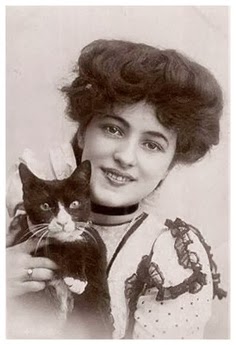
Jill's Cat

Fiction ~ short story
Published 1916
2,720 words
(First read 26/06/2013)